A/c Peptide Screening Laboratories Third-party Peptide Evaluation
Recognizing Peptide Purity Screening
FDA and the European EMA have actually developed standards mandating extensive analysis and quality assurance for peptide items to make sure safety and security and effectivenessr. In the context of pharmaceutical or clinical-grade peptides, laboratory validation is integral to fulfilling these guidelines. As an example, prior to a peptide medication can go into human tests, its manufacturer has to show the identity, purity, effectiveness, and safety and security of the peptide with validated logical approaches. Peptide purity testing data are obligatory in preclinical studies and must be consisted of in investigational new medication (IND) applications and later brand-new medicine applications (NDAs).
A useful assay measuring downstream signaling-- or an architectural research utilizing NMR or X-ray crystallography-- demands the highest pureness readily available. Crystallographers specifically frequently call for ≥ 98% purity because also small impurities can prevent crystal formation or present condition into the crystal lattice. As particles leave the column, they travel through a detector-- typically a UV detector set to 214 or 220 nm, wavelengths where Learn more the peptide bond absorbs light highly. The detector records just how much UV light is taken in in time, creating a graph called a chromatogram. This guide breaks down what pureness actually implies in peptide chemistry, exactly how it's gauged, what the impurities are, and just how to check out the documents that proves a peptide is what it asserts to be.- Most reports include a table listing each top's retention time, area, and percent of overall location.
- The detector records just how much UV light is soaked up over time, generating a chart called a chromatogram.
- Unlike a maker's in-house screening, independent third-party laboratory recognition is impartial and supplies impartial outcomes, adding reputation via unbiased logical data.
- Peptide screening is the collection of analytical checks utilized to examine a peptide example before it is used in a research workflow.
- Peptide purity is most generally identified by high-performance fluid chromatography (HPLC) with a detection wavelength of 220 nm, which is optimal for finding peptide bonds.
What A Worrying Chromatogram Appears Like
Unlike a producer's in-house screening, independent third-party laboratory validation is neutral and offers unbiased results, including credibility through objective analytical information. This procedure is crucial Go to the website for keeping high peptide top quality due to the fact that the peptide market is greatly unregulated in lots of places, and without validation some providers may use impure, mislabeled, or perhaps counterfeit peptides [3] Guaranteeing that each batch undergoes appropriate lab testing assists verify the peptide's authenticity and purity, which is essential for both research study credibility and safety. Peptide purity describes the percentage of your example that is the appropriate, full-length peptide sequence, free from other peptide-related contaminations. As an example, a purity of 98% suggests that 98% of the peptide material is the intended product, while the other 2% may be undesirable residues of synthesis (such as incomplete series or amino acid removal variations).
High-performance Liquid Chromatography
The Tops
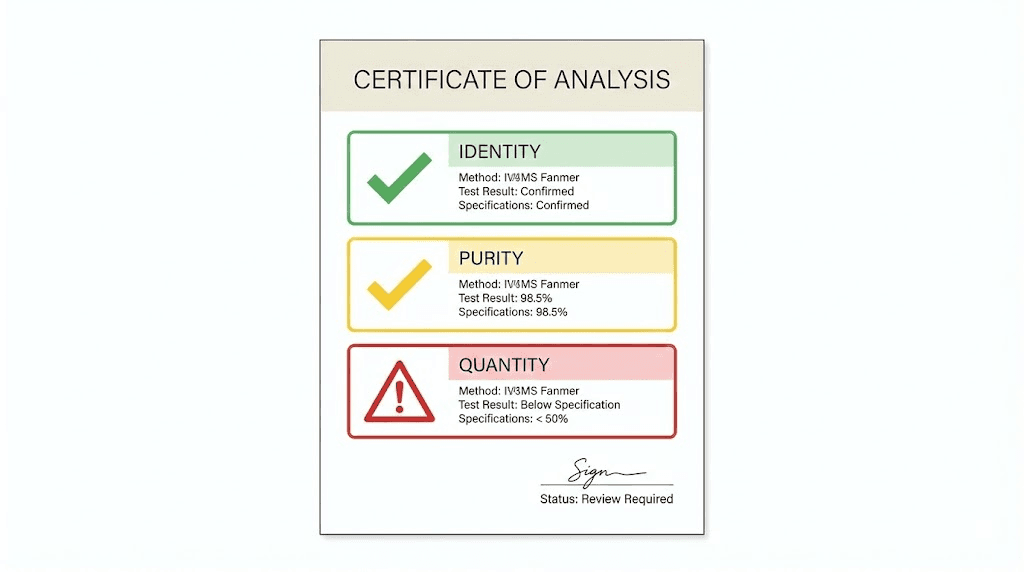
Pinnacle Research laboratory is a customized provider of high-purity chemical reagents and peptides. All products noted are strictly for in-vitro lab r & d use just. Check out front runner study peptides with batch-specific COA documents and HPLC/MS verification. Products are for in-vitro research laboratory research study use only and are not for human intake.Exact determination of the pI via capillary isoelectric concentrating (cIEF) helps in peptide characterization and is crucial for applications where peptide charge impacts function and security. We help identify chromatographic purity from actual peptide amount so clients can prepare solutions and compare lots with greater confidence. We pick techniques according to peptide length, hydrophobicity, cost account, and adjustment standing as opposed to compeling every sample right into one design template.
The gold standard for measuring peptide pureness is high-performance fluid chromatography, globally abbreviated as HPLC. If you see a purity percentage on a peptide product, it likely originated from an HPLC evaluation. This matters since peptides are constructed one amino acid at a time with solid-phase peptide synthesis (SPPS). At each step, there's a small opportunity that something goes wrong-- an amino acid does not affix, the incorrect adjustment occurs, or a side reaction produces an unexpected byproduct. Over a chain of 10, 20, or 40 amino acids, those tiny per-step error rates compound. A sample might create a clean-looking chromatogram with one leading top and still be the wrong substance if identity was never ever verified. HPLC steps splitting up and relative peak area; mass spectrometry measures mass-to-charge habits that can be utilized to verify molecular identification. Peptide purity testing is the procedure of verifying that a peptide example contains just the desired series-- and no considerable contaminants or results from synthesis. Because peptides are created through intricate chemical procedures, trace impurities can develop naturally. Testing permits scientists to understand specifically what remains in the vial, verifying both identification and quality. Selecting a trusted third-party lab is vital to obtaining reliable peptide recognition outcomes.